DIAGNOSIS YEAR
Select the diagnosis year first. J’Onco Mentor uses it to establish the standards cycle and to drive year-sensitive routing in this module.
INTERACTIVE BLADDER SITE SELECTOR
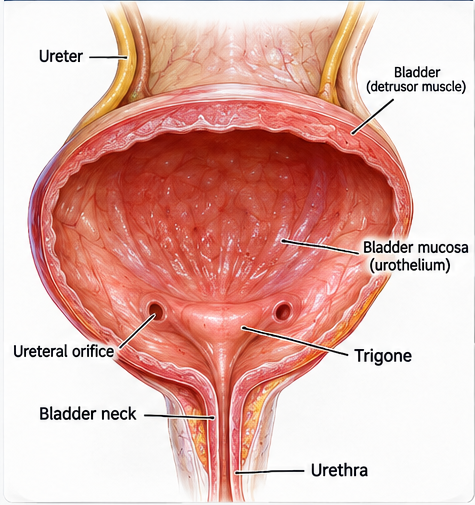
BLADDER TOPOGRAPHY
ALL BLADDER SUBSITES — C67.0 THROUGH C67.9
Every coded bladder subsite is displayed below. C67.8 (overlapping lesion) and C67.9 (bladder, NOS) are coding categories rather than discrete anatomic locations, so they are available here and in the dropdown but are not shown as anatomy hotspots.
Use the anatomy, full topography dropdown, or quick-select buttons. The dropdown provides the complete C67.0–C67.9 bladder topography set, including sites that cannot be reliably shown on a single frontal cutaway.
SELECTED BLADDER SITE(S)
CALCULATED PRIMARY SITE
No bladder site selected.
HISTOLOGY / SCHEMA CONTEXT
This mirrors the Histology field in the Site / Anatomy section. Select in either location; both remain synchronized.
SCHEMA ROUTING
Select site and histology to identify schema context.
MULTIPLE PRIMARY RULES — URINARY
Multiple bladder tumors
Multiple invasive urothelial carcinomas within the bladder may be abstracted as a single primary under the current urinary rules when applicable.
Multiple urinary organs
Urothelial tumors can involve bladder, ureter, renal pelvis or other urinary sites. Apply the current Urinary M rules rather than counting organs alone.
Overlap
A single tumor overlapping bladder subsites is coded C67.8 when the point of origin cannot be determined. Current urinary rules contain special instructions for urothelial CIS involving bladder and ureter.
AJCC STAGING
PATHOLOGIC STAGING CRITERIA — URINARY BLADDER
Qualifying evidence: TURBT can establish a pathological invasion category based on tissue actually present, including muscularis propria when sampled. Cystectomy permits broader assessment of local extent. Do not infer uninvolved layers or pN0 from unsampled tissues or nodes.
pT / pN: Assign only categories supported by the actual pathological evidence and the site-specific AJCC rules. A diagnosis-confirming biopsy does not automatically establish a pathological primary tumor category.
pM: Pathologically proven distant metastasis may support pM1 where the chapter permits; AJCC does not use pM0.
Treatment sequence: Distinguish initial pathological classification (pTNM) from post-neoadjuvant classification (ypTNM). Confirm eligibility, histology, staging chapter and diagnosis-year edition before finalizing.
Source / verification: AJCC · SEER tools and manuals. Educational overview only; verify exact chapter-specific criteria in the licensed AJCC manual.
Urinary Bladder AJCC staging schema / TNM context
Use the T, N and M controls and site-specific factors below. Verify final AJCC ID, TNM edition and stage group in the approved AJCC/SEER staging system for the diagnosis year.
AJCC 8 RESULT
| T | — |
|---|---|
| N | — |
| M | — |
| Stage Group | — |
Select T, N and M.
REGIONAL LYMPH NODES
Single true-pelvis node
Perivesical, obturator, internal iliac, external iliac, or sacral.
Multiple true-pelvis nodes
Multiple regional nodes within the true pelvis.
Common iliac nodes
Metastasis to common iliac lymph nodes.
EOD / SUMMARY STAGE
SEER*RSA Bladder Schema
Bladder topographies C67.0–C67.9 with applicable bladder histologies use the Bladder EOD schema. Exact EOD Primary Tumor, Regional Nodes and Mets codes should be assigned from the diagnosis-year SEER*RSA schema.
Summary Stage framework
In situ — noninvasive flat/papillary disease as applicable.
Localized — confined to bladder.
Regional — direct extension and/or regional nodes.
Distant — distant nodes or organs.
GRADE — BLADDER
GRADE GUIDANCE
Select histology to display the appropriate grade family.
For urothelial cancers, current SEER grade guidance prioritizes Low/High. If only G1–G3 is documented for urothelial carcinoma, code unknown as instructed. Adenocarcinoma and squamous cell carcinoma use numeric grades 1–3/9.
TURBT: qualifies for clinical grade; it does not qualify as the definitive resection required for pathological grade. Partial/complete cystectomy is required for the bladder pathological-grade context.
SURGERY OF PRIMARY SITE — BLADDER
—
No surgery selected.
Local destruction / intravesical
Includes fulguration, laser, intravesical therapy, and BCG/immunotherapy categories as defined by the surgery code table.
TURBT / excisional biopsy
SEER specifically directs TURB/TURBT to A270.
Partial cystectomy
Simple / total / complete cystectomy
Cystectomy with reconstruction
Includes ileal conduit and continent/orthotopic diversion variants.
Pelvic exenteration family
A710 includes radical cystectomy with anterior exenteration; use A710 for cystoprostatectomy or cystectomy with hysterectomy per SEER note.
COMMON METASTATIC SITES — BLADDER
Common distant sites include bone, liver and lung; SEER bladder training also identifies brain as a recognized metastatic site.
Bone
Liver
Lung
Brain
SOURCES
Coding guidelines, surgery, EOD linksSEER Solid Tumor Rules — Urinary
Current multiple-primary and histology rulesSEER*RSA EOD v3.3 — Bladder
NAACCR 2026 staging schemaSEER 2026 Bladder Surgery Codes
A-codes for TURBT, cystectomy, reconstruction, exenterationNCI Bladder Cancer Treatment PDQ
AJCC 8 T/N/M and stage-group referenceSEER Training — Bladder Anatomy
Bladder subsites and topography