DIAGNOSIS YEAR
Select the diagnosis year first. J’Onco Mentor uses it to establish the standards cycle and to drive year-sensitive routing in this module.
INTERACTIVE COLON & RECTUM PRIMARY-SITE SELECTOR
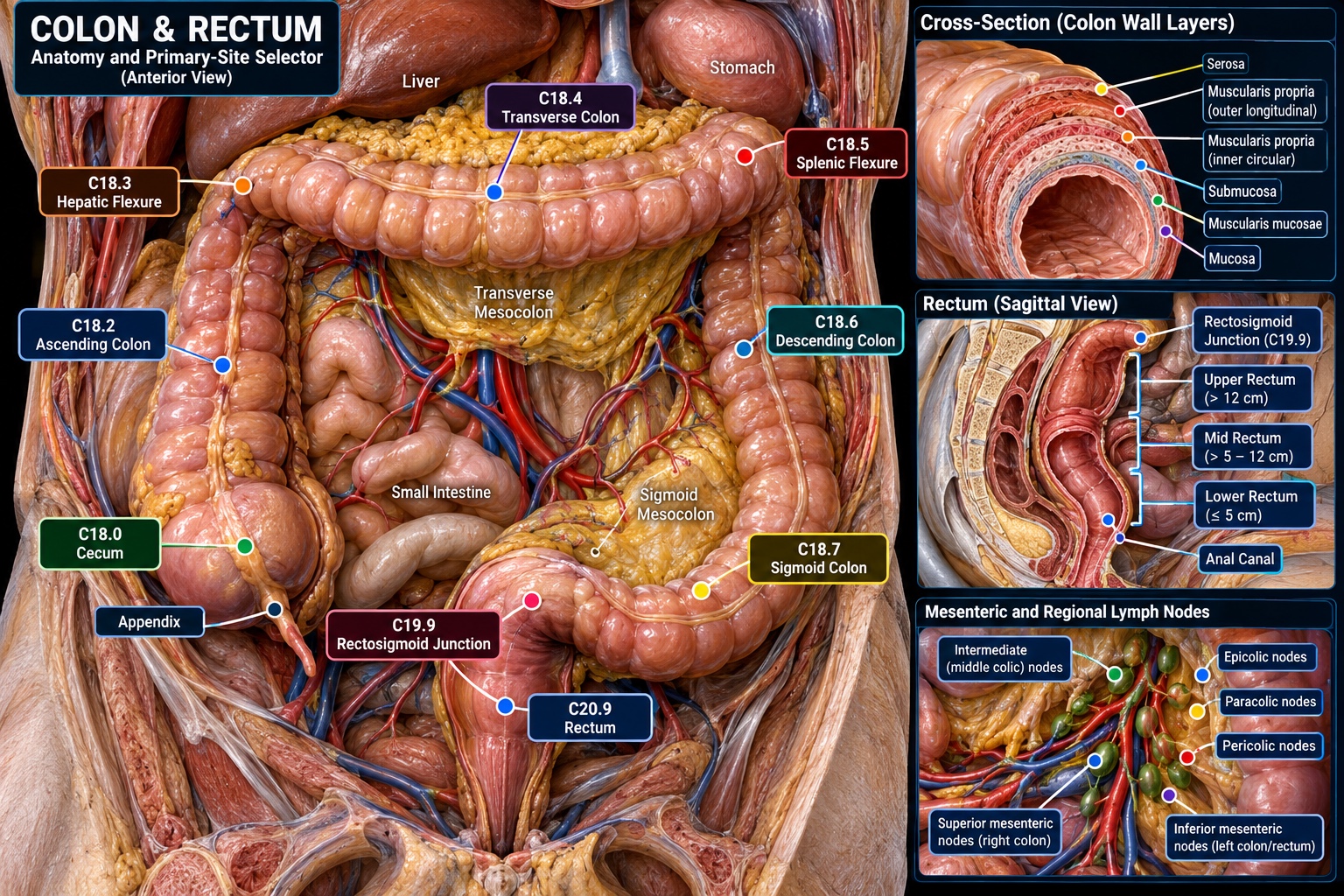
Click the documented site of origin on the anatomy image. C18.8 is used only for a single overlapping colon lesion when the point of origin cannot be determined; C18.9 is Colon, NOS.
—
Select one or more colorectal subsites.
SCHEMA ROUTING: C18.x and C19.9 use the Colon/Rectosigmoid carcinoma schema when histology qualifies. C20.9 uses the Rectum schema. GIST, well-differentiated NETs, sarcomas and selected other histologies route to other schemas.
HISTOLOGY & SCHEMA ROUTING
Colon and Rectum
Use the standard colorectal carcinoma workflow when site/histology criteria are met.
SEER 2027 — COLON, RECTOSIGMOID & RECTUM MULTIPLE PRIMARY RULES
INTERACTIVE MULTIPLE PRIMARY REVIEW
—
Select the case pattern and calculate.
KEY 2026 RULES
M3 — Single primary in qualifying FAP/polyposis: When adenocarcinoma in situ and/or invasive carcinoma is present in at least one polyp and there is a clinical diagnosis of FAP, more than 100 polyps, or carpeting polyposis, abstract a single primary.
Primary-site coding then depends on distribution. Examples from the rule include C18.9 when present in more than one colon segment and C19.9 when present in colon plus rectosigmoid or colon plus rectum.
M9 — Multiple primaries: Separate, non-contiguous tumors in colon sites that differ at the fourth character of C18.x are multiple primaries.
Example concept: separate sigmoid C18.7 and descending C18.6 tumors are abstracted separately when the rule applies.
M10 — Multiple primaries after disease-free interval: A subsequent tumor after the patient has been clinically disease-free for more than one year is a new primary.
If there is a recurrence within one year, the clock restarts from the date of the last recurrence. If recurrence history is unknown, use the diagnosis date for the interval calculation.
IMPORTANT RULE NOTES
- SEER 2026 Solid Tumor Rules — Colon, Rectosigmoid & Rectum Multiple Primary Rules
- Multiple tumors can still represent either one primary or multiple primaries.
- Collision tumors are treated as separate tumors for purposes of applying the multiple-tumor rules.
- Do not equate ordinary multiple colorectal polyps with FAP.
- When separate non-contiguous tumors are in different C18.x segments, review M9 before treating them as one overlapping lesion.
- A physician statement of “recurrence” does not override the Solid Tumor Rules; apply the rules in sequence.
- When site distribution crosses colon, rectosigmoid, and rectum, do not force C18.8. Use the applicable Multiple Primary Rules and documented site of origin.
REGIONAL LYMPH NODES
cN0
A named involved node group establishes regional nodal disease but does not determine the N subcategory without the required positive-node count or tumor-deposit details.
AJCC STAGING
PATHOLOGIC STAGING CRITERIA — COLON AND RECTUM
Qualifying evidence: A qualifying resection generally permits assessment of depth of invasion and pT. Examined regional nodes support pN, including tumor deposits where applicable. Endoscopic polypectomy/local excision can sometimes establish pT but does not automatically establish pN; evaluate the actual specimen and procedure.
pT / pN: Assign only categories supported by the actual pathological evidence and the site-specific AJCC rules. A diagnosis-confirming biopsy does not automatically establish a pathological primary tumor category.
pM: Pathologically proven distant metastasis may support pM1 where the chapter permits; AJCC does not use pM0.
Treatment sequence: Distinguish initial pathological classification (pTNM) from post-neoadjuvant classification (ypTNM). Confirm eligibility, histology, staging chapter and diagnosis-year edition before finalizing.
Source / verification: AJCC · SEER tools and manuals. Educational overview only; verify exact chapter-specific criteria in the licensed AJCC manual.
Colon / Rectum AJCC staging schema / TNM context
Use the T, N and M controls and site-specific factors below. Verify final AJCC ID, TNM edition and stage group in the approved AJCC/SEER staging system for the diagnosis year.
2026: Standard Colon/Rectum carcinoma staging remains AJCC 8; current SEER materials show Rectum Version 9 beginning with 2027 cases.
CLINICAL TNM
cTX
cN0
cM0
INCOMPLETE
Select cT, cN and cM to calculate cStage.
PATHOLOGIC TNM
—
—
—
INCOMPLETE
Select pT, pN and cM0 or a microscopically confirmed pM1 category to calculate pStage.
EOD — COLON & RECTUM
Code depth/extent from mucosa through wall, pericolic/perirectal tissue, visceral peritoneum, or contiguous organ invasion according to the current EOD table.
Regional-node definitions vary by colorectal subsite. Unnamed nodes removed with colon/rectal resection may be presumed regional per SEER's site-specific instruction.
Peritoneal involvement is a distinct distant-mets category. Distant-node lists differ for colon, rectosigmoid and rectum.
SUMMARY STAGE 2018
Noninvasive/intramucosal disease when reportable and meeting SS2018 criteria.
Tumor confined to the colorectal wall/local primary site without regional nodes or distant disease.
Regional extension, regional nodes, or both.
Distant organ, distant node, or peritoneal metastatic disease as defined by schema.
SSDI / GRADE
Capture clinical and pathologic grade using the current site/histology rules.
CEA and molecular/pathologic data items vary by diagnosis year and schema. This will be expanded next with field-by-field 2026 coding guidance.
2026 SURGERY — COLON / RECTOSIGMOID / RECTUM
Select a colorectal primary site above to load the correct 2026 surgery table.
—
No surgery selected.
The code will display here from the applicable 2026 SEER Colon, Rectosigmoid, or Rectum surgery table.
COMMON METASTATIC SITES — COLON & RECTUM
The most common distant metastatic organs for colorectal primaries are the liver and lung; peritoneal spread is also a major metastatic pattern.
Liver
One of the two most common metastatic sites for colon and rectum.
Lung
One of the two most common metastatic sites for colon and rectum.
Peritoneum
Important distant pattern, including discontinuous peritoneal implants/carcinomatosis when documented.
Distant lymph nodes
Iliac, retroperitoneal, or superior mesenteric nodes may be distant depending on the exact colorectal subsite and schema.