DIAGNOSIS YEAR
Select the diagnosis year first. J’Onco Mentor uses it to establish the standards cycle and to drive year-sensitive routing in this module.
INTERACTIVE CORPUS UTERI / ENDOMETRIUM ANATOMY
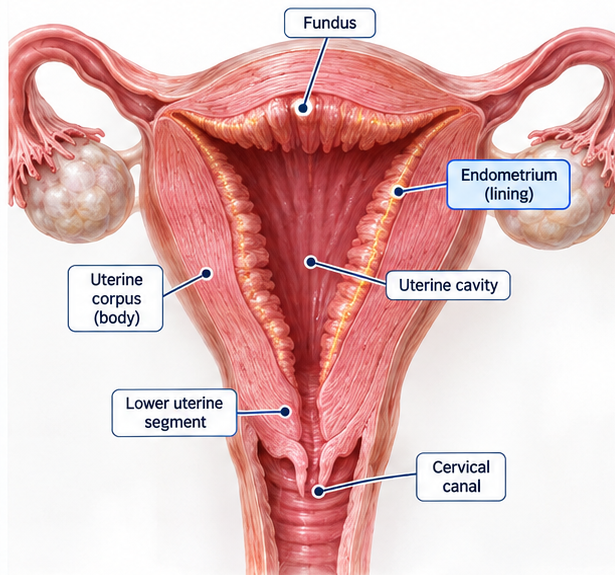 FUNDUSENDOMETRIUMISTHMUS / LOWER SEGMENTMYOMETRIUM
Select one or more involved corpus uteri subsites. Selecting multiple areas does not automatically change the primary site to C54.8.
Involved subsites: —
HISTOLOGY / SCHEMA ROUTING
SCHEMA RESULT
Select a histology.
MYOMETRIAL INVASION HELPER
AJCC STAGING SCHEMA
PATHOLOGIC STAGING CRITERIA — ENDOMETRIUM
Qualifying evidence: Hysterectomy generally provides definitive pathological assessment of myometrial invasion, cervical stromal involvement and other relevant tumor extent. Regional lymph node pathology supports pN where applicable. Check histology-specific staging rules and treatment sequence.
pT / pN: Assign only categories supported by the actual pathological evidence and the site-specific AJCC rules. A diagnosis-confirming biopsy does not automatically establish a pathological primary tumor category.
pM: Pathologically proven distant metastasis may support pM1 where the chapter permits; AJCC does not use pM0.
Treatment sequence: Distinguish initial pathological classification (pTNM) from post-neoadjuvant classification (ypTNM). Confirm eligibility, histology, staging chapter and diagnosis-year edition before finalizing.
Source / verification: AJCC · SEER tools and manuals. Educational overview only; verify exact chapter-specific criteria in the licensed AJCC manual.
Corpus Uteri AJCC / TNM Entry
Select the schema family that matches the documented histology, then enter T, N and M. Use the approved AJCC system for the final stage group.
AJCC / TNM RESULT
| Schema | — |
|---|---|
| T | — |
| N | — |
| M | — |
—
Histology determines which corpus uteri staging schema applies. Verify the final AJCC/FIGO stage group in the approved staging system.
REGIONAL LYMPH NODES
Pelvic nodes
Includes pelvic nodal groups used by the applicable corpus uteri schema. Record examined and positive pelvic nodes when required.
Para-aortic nodes
Record examined and positive para-aortic nodes separately when required by the schema/SSDI.
EOD / SUMMARY STAGE
EOD
Use the applicable corpus schema selected by site and histology. EOD Primary Tumor, EOD Regional Nodes and EOD Mets derive staging outputs according to SEER*RSA.
Summary Stage 2018
Use the diagnosis-year SEER*RSA derivation. Do not convert AJCC stage group directly to Summary Stage.
SURGERY — CORPUS UTERI (2026)
COMMON METASTATIC SITES — ENDOMETRIAL / CORPUS UTERI
Lung
Common distant site in advanced disease.
Liver
Recognized site of hematogenous spread.
Bone
Can occur in advanced or recurrent disease.
Peritoneum / distant nodes
May represent distant spread depending on the documented site and applicable staging system.