DIAGNOSIS YEAR
Select the diagnosis year first. The selected year determines the applicable standards context and must be verified before staging or coding.
Stomach anatomy & multiple-site selection
Select one or more regions on the anatomical diagram or in the checklist. Anatomical selection and final primary-site coding are distinct decisions.
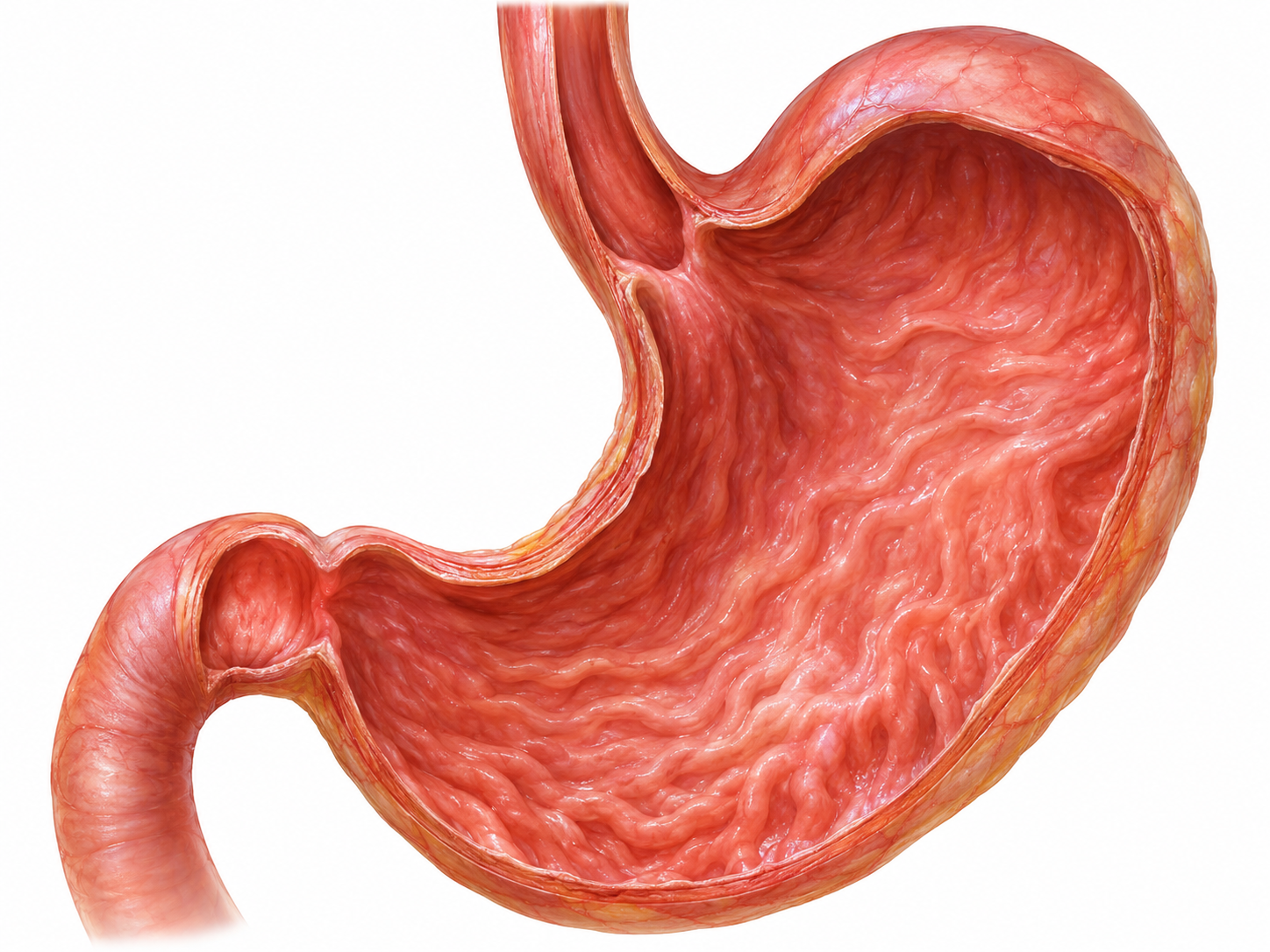
Select highlighted anatomical regions on the realistic cutaway. Labels show anatomical landmarks and ICD-O-3 subsites. Regions are approximate interactive overlays, not diagnostic boundaries; curvature codes and GEJ require documentation review.
Selected anatomical sites
Selected sites
Calculated primary site
Multiple regions alone do not establish C16.8. Confirm a single continuous lesion, adjacent subsite involvement, and whether the point of origin is known. Separate tumors require multiple-primary assessment.
ICD-O-3 topography & histology
Topography reference
| Code | Site |
|---|
Histology lookup
Common stomach histologies are included as a starter lookup, not a complete ICD-O-3 histology catalog. Verify year-specific validity and reportability with the current ICD-O-3 and SEER resources.
Stomach lymph node regions
Select multiple stations on the reference diagram or using the station buttons. The diagram is an educational visual draft; its AJCC v9 title and regional classifications have not been verified and must not be used to determine staging eligibility.
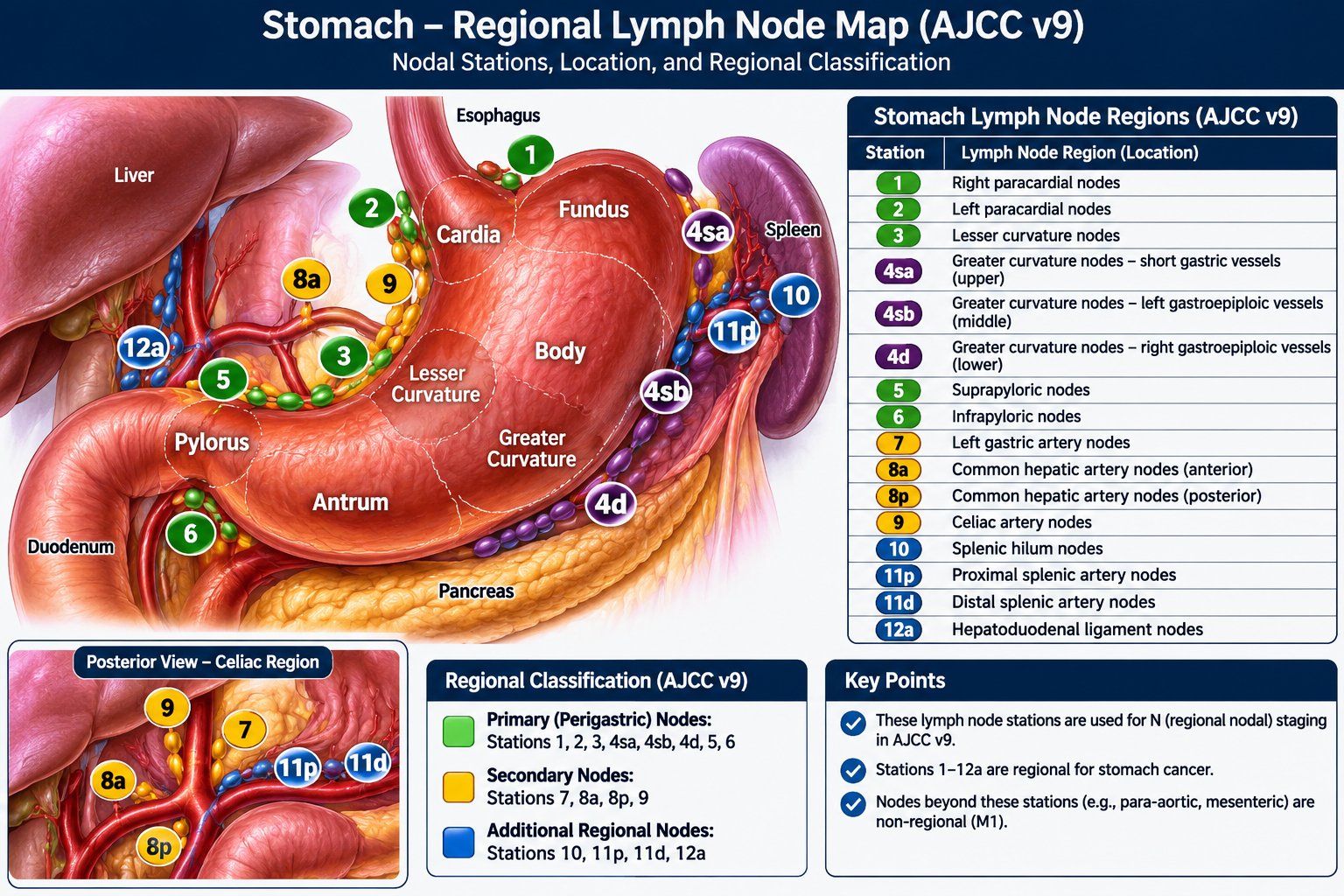
LYMPH NODE STATIONS
None selected
Stations 7, 8p, and 11d can be selected from the buttons because they are shown in the inset or table rather than as clearly located main-diagram targets. Selecting a station reveals its positive-node count field in the calculator immediately below this station-selection section. Gastric carcinoma N category depends on the total number of involved regional lymph nodes, not the number of stations selected.
AUTO N CATEGORY CALCULATOR — STOMACH
Step 1: Select one or more stations on the diagram or in the station list above. Step 2: Enter the number of positive regional lymph nodes for each selected station. Step 3: Mark assessment complete to assign the pathological N category.
Calculated N category: Pending assessment
Select stations on the diagram or station list above, then enter the number of positive regional lymph nodes at each station. A station is not equivalent to one lymph node. Counts are not automatically assumed from a selection.
No stations selected. Select one or more lymph node stations above to enter positive-node counts.
Total positive regional lymph nodes: 0
N category pending assessment.
Automatic N-category transfer applies only to the eligible stomach carcinoma pathological (pTNM) pathway. Clinical and post-treatment N categories require separate evaluation. Verify station eligibility and node counts against the applicable AJCC chapter.
AJCC staging calculator
PATHOLOGIC STAGING CRITERIA — STOMACH
Qualifying evidence: A qualifying gastrectomy or other adequate resection generally supports pT. Pathological pN for gastric carcinoma is based on the number of positive regional lymph nodes: N0 = 0; N1 = 1–2; N2 = 3–6; N3a = 7–15; N3b = 16 or more. Station selection alone cannot determine pN.
pT / pN: Assign only categories supported by the actual pathological evidence and the site-specific AJCC rules. A diagnosis-confirming biopsy does not automatically establish a pathological primary tumor category.
pM: Pathologically proven distant metastasis may support pM1 where the chapter permits; AJCC does not use pM0.
Treatment sequence: Distinguish initial pathological classification (pTNM) from post-neoadjuvant classification (ypTNM). Confirm eligibility, histology, staging chapter and diagnosis-year edition before finalizing.
Source / verification: AJCC · SEER tools and manuals. Educational overview only; verify exact chapter-specific criteria in the licensed AJCC manual.
Staging result
Stage groups are calculated for eligible stomach carcinoma using AJCC 8th-edition clinical, pathological, and post-neoadjuvant groupings. GIST and NET stage groups remain withheld pending pathway-specific verification. Review diagnosis year, GEJ eligibility, histology, and applicable staging rules before registry use.
AJCC chapter routing
Surgery of primary site — Stomach
Select diagnosis year at the top of the module before using this reference. The codes below are from the SEER 2026 Stomach Surgery Codes (C160–C169), Surgery of Primary Site 2023 coding system. Historical diagnosis years require the applicable year-specific manual.
Additional stomach surgery codes and procedure-specific instructions are available in the official manual. Do not infer a code from a procedure name without reviewing the operative report and applicable instructions.
Selected surgical treatment
No surgical treatment selected.
Select a diagnosis year to confirm the applicable coding reference.
Coding summary
SOURCES
Official reference resources for the Stomach Module.
Educational reference only. Gastric carcinoma, GIST, and neuroendocrine tumors have distinct staging pathways; verify chapter eligibility and regional nodal definitions before assigning stage.