J’Onco Mentor Version 9.09 — HEMATOPOIETIC & LYMPHOID PRIMARIES

Desktop version. Mobile app coming.

WHAT IS J’ONCO MENTOR?LUNGBREASTHEAD & NECKPROSTATEENDOMETRIUMLIVERADRENAL GLANDKIDNEYTHYROIDBLADDERCOLON & RECTUMMELANOMA OF SKINPANCREASSTOMACHCNSHEMATOPOIETIC DISORDERSTOP CANCER SITESSTORE MANUALRADIATION GUIDESTATE REPORTABILITYICD-10-CM / SECONDARY DXODS RESOURCES
AJCC STAGINGSTAGINGDIAGNOSIS / HISTOLOGYSCHEMA DISCRIMINATORPRIMARY SITEMULTIPLE PRIMARY CALCULATORMULTIPLE PRIMARY RULES / TRANSFORMATIONCOMMON INVOLVEMENTSOURCES

DIAGNOSIS YEAR

Select the diagnosis year first. J’Onco Mentor uses it to establish the standards cycle and to drive year-sensitive routing in this module.

SEER manual—
NAACCR cycle—
Staging context—
Standards statusSelect year
No diagnosis year selected. Year-dependent schema, staging, SSDI, grade, surgery, and manual guidance should not be assumed.

AJCC STAGING SCHEMA / TNM ENTRY

PATHOLOGIC STAGING CRITERIA — HEMATOPOIETIC / LYMPHOMA

Qualifying evidence: Most hematopoietic malignancies do not use conventional AJCC pTNM. Lymphoma staging may use a disease-specific clinical staging system; leukemia and other hematopoietic neoplasms have separate classification frameworks. Do not infer pTNM from biopsy or marrow findings.

pT / pN: Assign only categories supported by the actual pathological evidence and the site-specific AJCC rules. A diagnosis-confirming biopsy does not automatically establish a pathological primary tumor category.

pM: Pathologically proven distant metastasis may support pM1 where the chapter permits; AJCC does not use pM0.

Treatment sequence: Distinguish initial pathological classification (pTNM) from post-neoadjuvant classification (ypTNM). Confirm eligibility, histology, staging chapter and diagnosis-year edition before finalizing.

Source / verification: AJCC · SEER tools and manuals. Educational overview only; verify exact chapter-specific criteria in the licensed AJCC manual.

Important: AJCC TNM is not a universal staging system for hematopoietic neoplasms. The fields below allow manual TNM-style capture when required by a local workflow, but they do not calculate an AJCC stage group.


TNM CAPTURE

T—
N—
M—

—

Use the Hematopoietic Staging Guide for the disease-appropriate staging/classification system.

HEMATOPOIETIC STAGING GUIDE
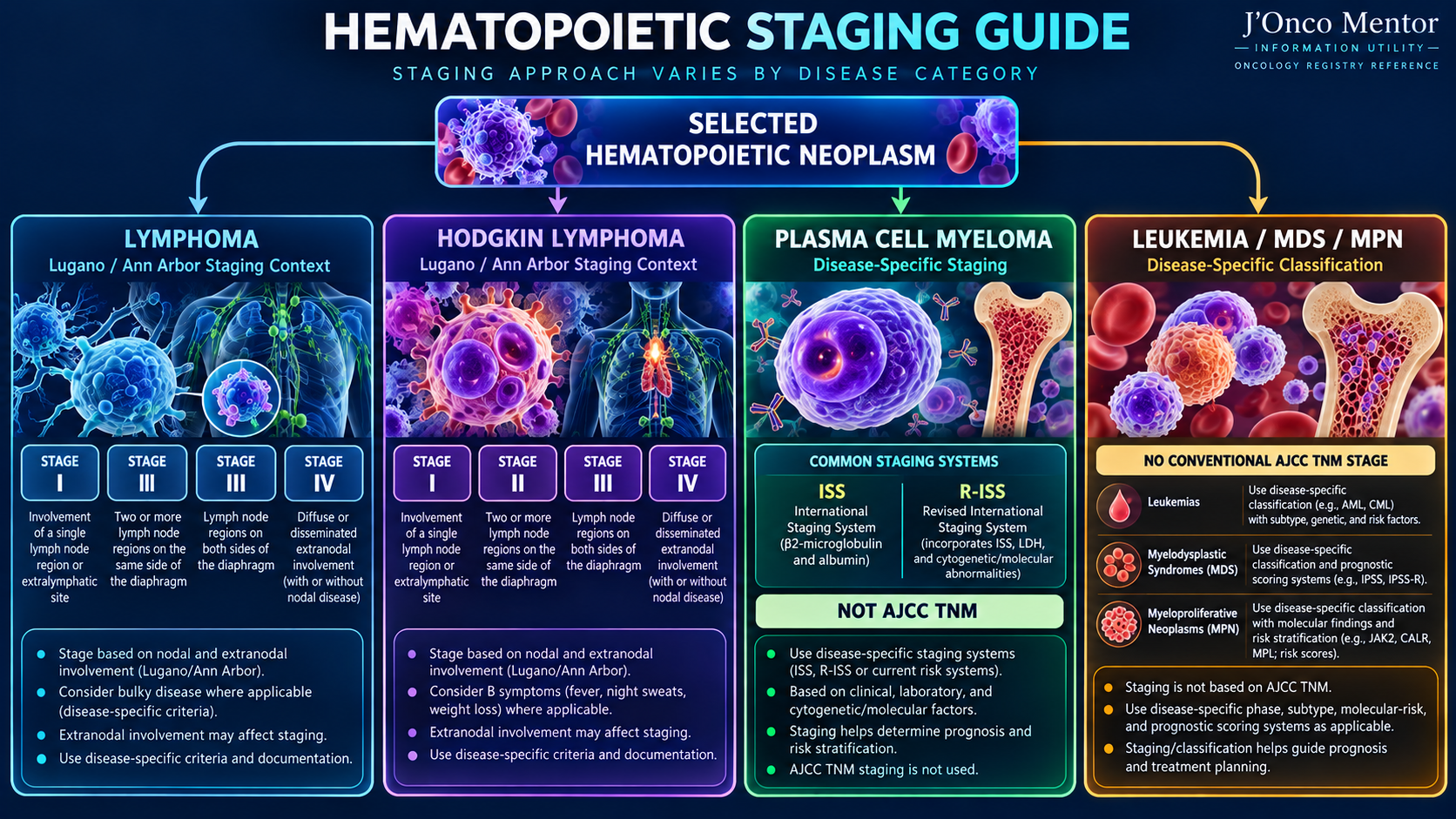
Hematopoietic staging guide comparing lymphoma, Hodgkin lymphoma, plasma cell myeloma, and leukemia MDS MPN classification

DIAGNOSIS / HISTOLOGY SEARCH

Type a code or name, or use the dropdown below. Both controls stay synchronized.

Search the full C00.0–C80.9 topography list by ICD-O code or site name. Examples: C42.1 or Bone marrow; C77.0 or Lymph nodes of head, face and neck. Choose the exact documented primary site.

SELECTED HISTOLOGY

LINEAGE:

COMMON / MOST LIKELY PRESENTATION:

REGISTRY PRIMARY SITE:

Do not assign primary site from histology alone. Apply the current Heme DB/Manual primary-site rules to documented disease distribution.

FULL CURRENT SEER HEME DB — 226 NEOPLASMS

The web Heme DB is the authoritative complete catalog and is updated by SEER. Search by morphology code or diagnosis term.

SCHEMA DISCRIMINATOR 1 — AUTO CALCULATOR

NAACCR Item #3926. Schema Discriminator 1 is required only for selected hematopoietic cases when site and histology alone are not sufficient to identify the correct staging/schema pathway. The calculator uses the selected topography + histology first, then activates the terminology selector when Schema Discriminator 1 is required.
—
—
Select a histology above. The calculator will indicate whether a discriminator is required.
AUTO-CALCULATED SCHEMA DISCRIMINATOR 1

—

—

SCHEMA ROUTE: —

Do not infer the discriminator. For 9591/3, use the terminology in the pathology report. For 9732/3, use the terminology documented by the physician/pathology record; do not determine the myeloma term yourself from AJCC diagnostic criteria.

PRIMARY SITE GUIDANCE

COMMON SITE ≠ AUTOMATIC PRIMARY SITE CODE. J'Onco Mentor separates common presentation from the registry primary-site decision. Use the Heme DB/Manual for the actual C-code.

SEER MULTIPLE PRIMARIES CALCULATOR — HEMATOPOIETIC

SEER workflow: Review Multiple Primary Rules M1–M14 first. Use the SEER Multiple Primaries Calculator only when the applicable rule directs you to it (typically M15). This calculator is designed for comparisons where at least one diagnosis is from 2010 or later.
CALCULATOR STATUS

Waiting for input

NUMBER OF PRIMARIES

—

COMPARISON

—

SEER MPC GUIDANCE

Enter two morphology codes/diagnoses and diagnosis years.

OPEN OFFICIAL SEER HEME DB / MULTIPLE PRIMARIES CALCULATOR ↗
Important: J’Onco Mentor does not replace the SEER Heme Manual or official web calculator. When a pair is not one of the locally validated relationships below, the result will instruct you to verify the pair in the official SEER calculator rather than guess.

HEMATOPOIETIC MULTIPLE PRIMARY / TRANSFORMATION REVIEW

MULTIPLE PRIMARY RULE USED

NUMBER OF PRIMARIES

FINAL DIAGNOSIS / HISTOLOGY

RULE RATIONALE

Use the SEER Multiple Primaries Calculator only when the current Heme Manual directs you to use it.

COMMON SITES OF INVOLVEMENT — HEMATOPOIETIC / LYMPHOID NEOPLASMS

Hematopoietic and lymphoid neoplasms do not always follow the same “primary solid tumor → metastasis” model. For lymphoma primary-site determination, SEER identifies several sites that are commonly secondary involvement.

Bone

Common secondary/metastatic involvement for lymphoma primary-site determination.

Bone marrow

Common secondary involvement; coded in Mets at Dx—Other when applicable, with important primary-site exceptions.

Distant lymph nodes

Common secondary involvement; treatment of nodal disease depends on the specific lymphoma primary and rules.

Liver

Common secondary involvement.

Lung

Common secondary involvement.

Brain / CNS

Can represent secondary involvement, while true primary CNS lymphomas also exist.

Heme-specific reminder: Do not use these sites alone to assign the primary site. Apply the current SEER Hematopoietic and Lymphoid Neoplasm Database/Manual rules. Spleen involvement is not coded as metastatic disease for lymphomas.

SOURCES

\n\n