DIAGNOSIS YEAR
Select the diagnosis year first. J’Onco Mentor uses it to establish the standards cycle and to drive year-sensitive routing in this module.
INTERACTIVE PANCREAS PRIMARY-SITE SELECTOR
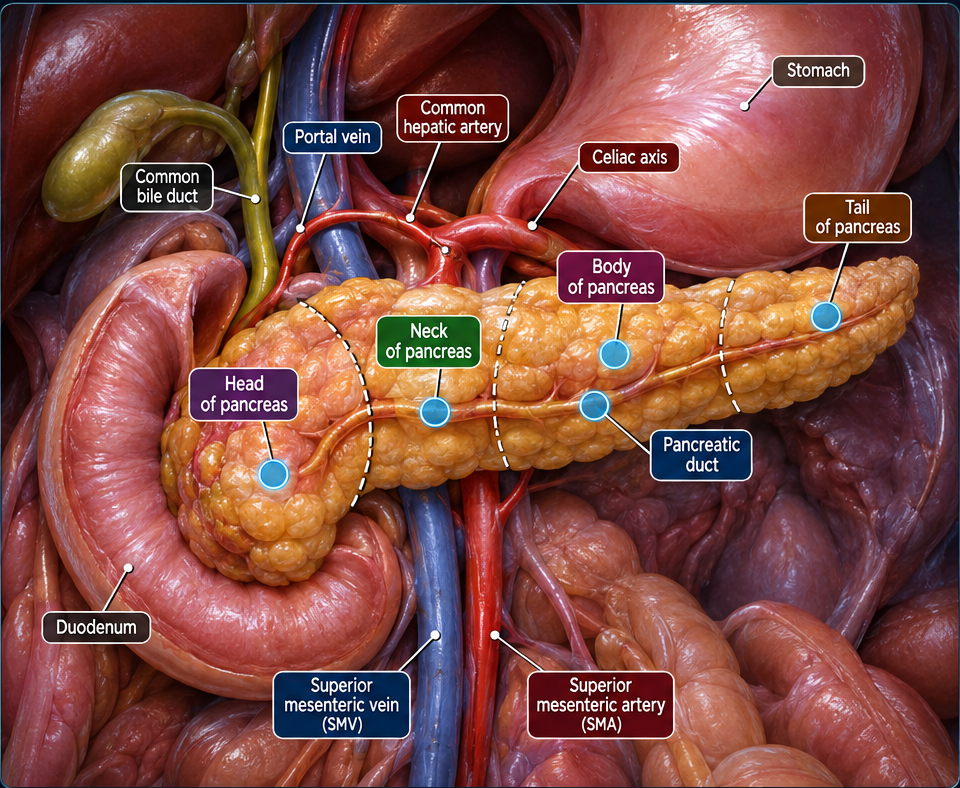
Click a cyan pancreatic site marker on the realistic anatomy. Click the active marker again to deselect it. Use the dropdown for endocrine pancreas NOS, overlapping lesion, or pancreas NOS.
Selecting an additional site here adds it immediately. Diagram selections and this field stay synchronized.
—
No pancreatic site selected.
Assign the code for the point of origin. Multiple selected subsites do not automatically mean C25.8. Use C25.8 only when the lesion overlaps two or more pancreatic subsites and the point of origin cannot be determined. For an islet-cell/NET tumor, use head/body/tail when the subsite is known; use C25.4 when the endocrine/islet subsite cannot be determined.
HISTOLOGY / TUMOR FAMILY
SCHEMA ROUTING
—
The current SEER EOD framework separates Pancreas (excluding neuroendocrine tumor) from Neuroendocrine Tumors of Pancreas. Choose the tumor family before using staging guidance.
MULTIPLE PRIMARY RULES
CURRENT RULE SET
OTHER SITES
Pancreas is handled under the SEER Solid Tumor Rules — Other Sites site group for cases diagnosed 1/1/2023 forward.
WORKFLOW
- Establish reportability and behavior.
- Determine whether disease represents recurrence before applying M rules.
- Apply Other Sites multiple-primary rules.
- Apply Working Histology Determination / histology rules.
The November 2026 Solid Tumor Rules release includes recurrence-rule updates. Always use the rule set appropriate to the diagnosis year and implementation guidance.
REGIONAL LYMPH NODES — STARTER MAP
NEXT DIAGRAM PASS
A dedicated interactive pancreas lymph-node diagram will be added after the node groups are validated against the current SEER/AJCC schema by pancreatic subsite and tumor family.
This prevents a generic node map from implying that every regional basin applies identically to every pancreatic subsite.
AJCC STAGING SCHEMA
PATHOLOGIC STAGING CRITERIA — PANCREAS
Qualifying evidence: Qualifying pancreatic resection (for example, pancreaticoduodenectomy or distal pancreatectomy) generally supports pT. Examined regional lymph nodes support pN. Confirm the chapter appropriate to histology, especially pancreatic neuroendocrine tumors.
pT / pN: Assign only categories supported by the actual pathological evidence and the site-specific AJCC rules. A diagnosis-confirming biopsy does not automatically establish a pathological primary tumor category.
pM: Pathologically proven distant metastasis may support pM1 where the chapter permits; AJCC does not use pM0.
Treatment sequence: Distinguish initial pathological classification (pTNM) from post-neoadjuvant classification (ypTNM). Confirm eligibility, histology, staging chapter and diagnosis-year edition before finalizing.
Source / verification: AJCC · SEER tools and manuals. Educational overview only; verify exact chapter-specific criteria in the licensed AJCC manual.
Pancreas AJCC / TNM Entry
Choose the applicable pancreatic tumor family, then enter T, N and M. J’Onco Mentor displays the TNM combination for abstracting support; verify the final AJCC stage group in the approved AJCC staging system for the diagnosis year.
AJCC / TNM RESULT
| Schema | — |
|---|---|
| T | — |
| N | — |
| M | — |
—
Final stage group requires the tumor-family-specific AJCC rules. Verify in AJCC / your approved staging application.
EOD / SUMMARY STAGE
EOD SCHEMAS
Pancreas — excluding NETNeuroendocrine Tumors of PancreasFor NAACCR v26 / diagnosis year 2026, use the current SEER*RSA EOD v3.3 schema.
SUMMARY STAGE 2018
Keep Summary Stage coding separate from AJCC stage. The module will eventually translate documented extension/nodes/metastasis into a guided Summary Stage review without substituting for the official schema.
SSDI / GRADE
Effective for diagnosis years 2021+. Record the highest documented pretreatment CA 19-9 value to the nearest tenth when an exact value is available.
Grade logic differs for pancreatic NETs; do not infer NET grade from generic “well differentiated/low grade” terminology when the schema requires physician G1/G2/G3 or Ki-67/mitotic-count rules.
SURGERY OF PRIMARY SITE — PANCREAS
—
No surgery selected.
Local excision
Local excision / enucleation; includes laser destruction, thermal therapy, or ablation.
Partial pancreatectomy
Partial pancreatectomy, NOS; example: distal or subtotal pancreatectomy.
Whipple family
Pancreaticoduodenectomy; B351 pylorus-preserving; B352 with partial gastrectomy/classic Whipple.
Total pancreatectomy
Extended resection
Total pancreatectomy with subtotal gastrectomy and/or duodenectomy / extended pancreatoduodenectomy.
Other / unknown
Pancreatectomy NOS; surgery NOS; unknown if surgery performed.
COMMON METASTATIC SITES — PANCREAS
Pancreatic cancers commonly spread to the liver, peritoneum, and lung. SEER Training also identifies bone as a hematogenous metastatic site.
Liver
Major distant metastatic site for pancreatic primaries.
Peritoneum
Common pattern of distant spread, including peritoneal seeding/carcinomatosis when documented.
Lung
Common hematogenous distant site.
Bone
Recognized hematogenous metastatic site in SEER training material.