DIAGNOSIS YEAR
Select the diagnosis year first. J’Onco Mentor uses it to establish the standards cycle and to drive year-sensitive routing in this module.
HEAD & NECK PRIMARY SITE SELECTOR
SITE GROUP:
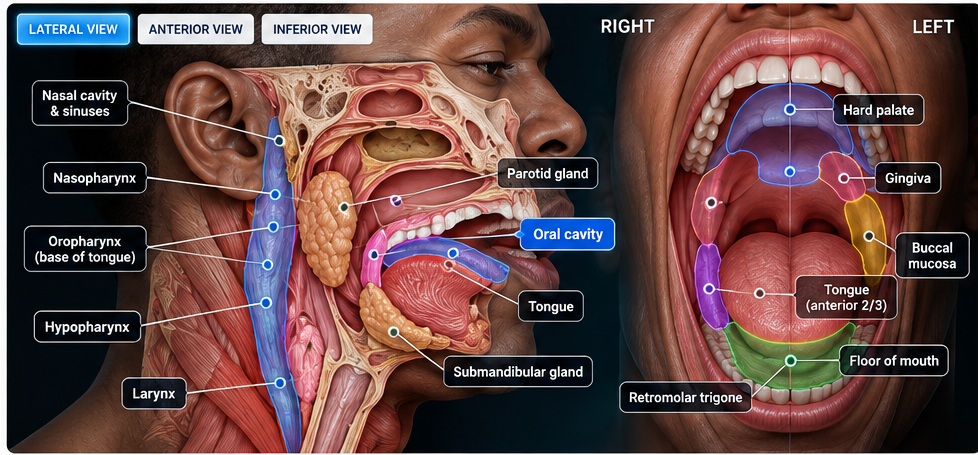
This realistic anatomy view is an orientation aid. Use the documented primary site and current registry rules for final coding.
ICD-O-3 HISTOLOGY
INTERACTIVE LYMPH NODE LEVELS & NODAL STAGING
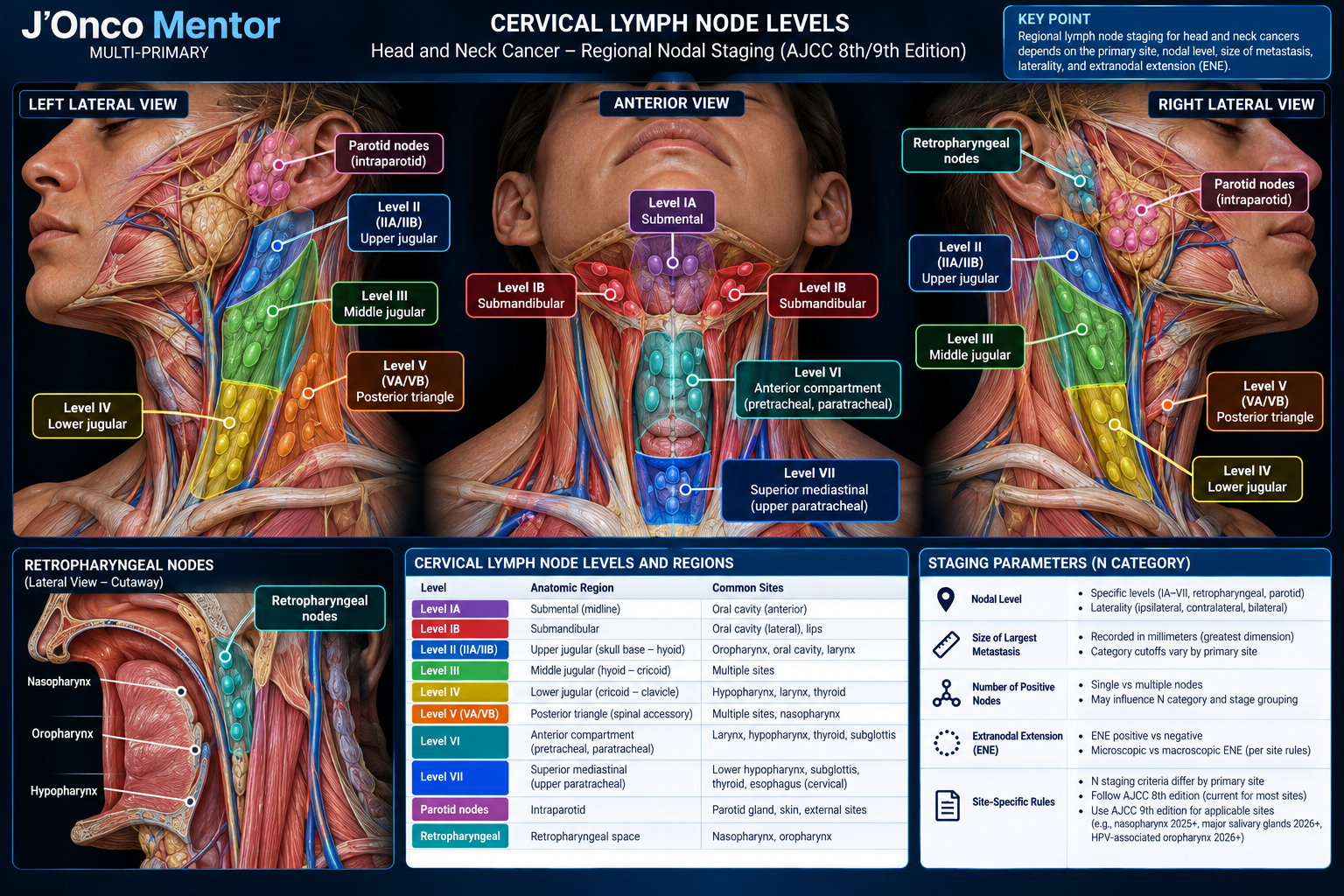
Click a nodal level on the diagram or add a level from the dropdown. The selected distribution, size, node count, laterality and ENE are used to suggest a clinical N category. Verify the final category in the site-specific AJCC/SEER schema.
IA submental; IB submandibular / sublingual
Upper jugular; IIA anterior and IIB posterior
Middle jugular / middle deep cervical
Lower jugular / lower deep cervical; Virchow region
Posterior triangle; VA spinal accessory, VB transverse cervical / supraclavicular
Anterior compartment: prelaryngeal, pretracheal, paratracheal and related groups
Superior mediastinal / upper paratracheal region
Retropharyngeal, parotid, facial, preauricular, retroauricular, parapharyngeal and other site-specific regional groups
AJCC STAGING
PATHOLOGIC STAGING CRITERIA — HEAD AND NECK
Qualifying evidence: Qualifying primary-site resection generally supports pT; regional lymph node pathology supports pN. The rules vary substantially by subsite and chapter, including HPV-mediated oropharynx and EBV-associated nasopharynx, and extranodal extension where applicable.
pT / pN: Assign only categories supported by the actual pathological evidence and the site-specific AJCC rules. A diagnosis-confirming biopsy does not automatically establish a pathological primary tumor category.
pM: Pathologically proven distant metastasis may support pM1 where the chapter permits; AJCC does not use pM0.
Treatment sequence: Distinguish initial pathological classification (pTNM) from post-neoadjuvant classification (ypTNM). Confirm eligibility, histology, staging chapter and diagnosis-year edition before finalizing.
Source / verification: AJCC · SEER tools and manuals. Educational overview only; verify exact chapter-specific criteria in the licensed AJCC manual.
Head & Neck AJCC staging schema / TNM context
Use the T, N and M controls and site-specific factors below. Verify final AJCC ID, TNM edition and stage group in the approved AJCC/SEER staging system for the diagnosis year.
AJCC Version 9 for 2025+.
AJCC Version 9 for 2026+.
AJCC Version 9 for 2026+.
PATHOLOGIC STAGING — pTNM
—
—
—
VERIFY SCHEMA
Select pT, pN, and pM. Because Head & Neck pathologic stage grouping is schema-specific, this utility preserves the components and prompts verification rather than applying one generic stage-group table to every site.
HPV / P16 / EBV
HPV-associated oropharyngeal staging uses AJCC Version 9 beginning in 2026. p16 immunotesting is mandatory to use the HPV-associated schema; HPV ISH may be used as an alternative.
HEAD & NECK MULTIPLE PRIMARY RULES & CALCULATOR
INTERACTIVE MULTIPLE PRIMARY REVIEW
—
Select the case pattern and calculate.
EARLY 2026 RULES IMPLEMENTED
M1: When it is not possible to determine whether there is a single tumor or multiple tumors after all information sources are exhausted, handle as a single primary.
M2: A single tumor is a single primary, even when it overlaps or extends into adjacent/contiguous sites or subsites.
M3: Separate/non-contiguous tumors in certain specifically listed fourth-character site pairs/groups are multiple primaries. Examples include glottis/supraglottis/subglottis, hard palate/soft palate/uvula, maxilla/mandible, and upper/lower gum.
M4: Separate/non-contiguous tumors in sites whose ICD-O topography codes differ at the second and/or third character are multiple primaries.
WHEN TO CONTINUE THE RULES
When multiple tumors remain within the same site family or do not meet the early site-based rules, continue through the current Head & Neck rules. Histology, timing, and other rule-specific criteria may determine one versus multiple primaries.
SURGERY OF PRIMARY SITE — 2026
—
No surgery selected.
CODING CONTEXTThe dropdown automatically changes with the selected primary site and uses the corresponding 2026 SEER Appendix C Surgery of Primary Site code family.
COMMON METASTATIC SITES — HEAD & NECK
Distant spread patterns vary by the specific head-and-neck primary site. SEER Training lists the following common patterns.
| Primary site group | Common distant metastatic sites |
|---|---|
| Oral cavity, pharynx, larynx | Lungs, liver, mediastinal lymph nodes |
| Maxillary sinus | Lungs, distant lymph nodes |
| Salivary glands | Lungs |
| Thyroid gland | Lungs |